
Building better API integrations: what we’ve learned
If you don’t think about resilience, performance, and long-term maintenance from day one, you’ll pay for it later.

👋 Hi, I’m Thomas. Welcome to a new edition of Beyond Runtime, where I dive into the messy, fascinating world of distributed systems, debugging, AI, and system design. All through the lens of a CTO with 20+ years in the backend trenches.
QUOTE OF THE WEEK:
“Any endeavor has unintended consequences. Any ill-conceived endeavor has more.” — Stephen Tobolowsky
TL;DR
Here’s the summary of key API integration best practices I recommend every engineering team adopt:
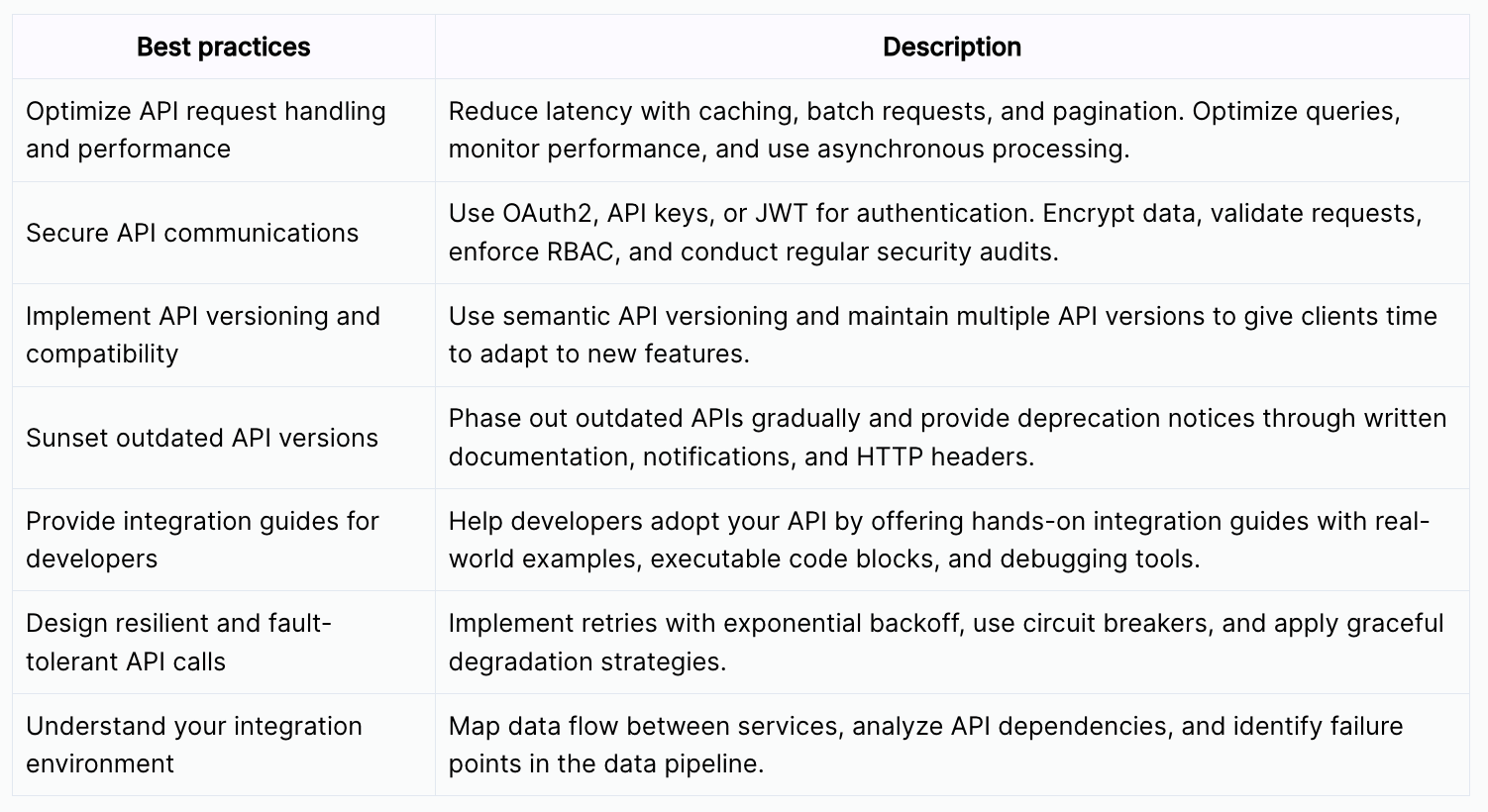
By now, most teams know the pain of a brittle API integration. Maybe it was a payment provider that went down unexpectedly. Or a legacy internal API that returned inconsistent data formats. Or worse: an undocumented downstream dependency that blew up your service during a Friday deploy.
Here’s what my team and I have learned about making API integrations more resilient, scalable, and maintainable (based on real-world debugging, system mapping, and a few too many “why did this break?” moments).
1. Performance is architecture
Poorly handled API calls create invisible bottlenecks. You can waste a ton of compute and user patience if you’re not caching intelligently, batching requests, or paginating properly.
Latency creeps in quietly. One integration gets chatty, another calls your service in a loop, and suddenly you’re seeing CPU spikes and missed SLAs. To fight this:
Use caching (Redis, Memcached, HTTP headers)
Batch requests instead of spamming small ones
Paginate large payloads and filter aggressively
Offload long-running tasks with background jobs (Celery, Sidekiq)
2. Secure everything by default
APIs are attack surfaces. Whether it’s an open endpoint, misconfigured token, or leaked key, integration points are often where things go wrong.
What works:
Use OAuth2 or scoped JWTs (never permanent API keys in code)
Validate inputs aggressively; whitelist what’s allowed
Use TLS 1.2+ and enforce HSTS
Protect against common threats: CORS misconfig, CSRF, injection
Security issues in integrations don’t always show up right away—but when they do, they’re usually systemic. Also good API security is layered. Don’t rely on one magic middleware to save you.
3. Versioning is a product decision
Versioning is inevitable. It’s better to plan for it than scramble to bolt it on.
Semantic versioning matters more than people might think
Serve multiple versions in parallel (path or header-based)
Plan your deprecation strategy and communicate it in code (HTTP headers, response messages) and in the changelogs
Versioning is hard not because of code, but because of coordination. Expect people to lag behind, and build for that.
4. Build for fault tolerance
Consuming someone else’s API means inheriting their problems. Network flakiness, downtime, rate limiting… they’re all your concern now. Use:
Use exponential backoff, not blind retries
Wrap risky flows in circuit breakers (Opossum in Node.js is a good one)
Cache stale-but-usable data as a fallback
Don't assume 200 OK means everything worked. Parse responses properly
5. Understand the integration surface
Before wiring up an API, map the system. What services depend on what? What data flows between them? What fails if the API slows down? This means:
Building (or auto-generating) service maps
Identifying critical paths and dependencies
Monitoring third-party APIs like your own
No amount of clever retry logic can compensate for not knowing how the pieces fit together.
Tools like OpenTelemetry, distributed tracing, or Multiplayer’s debugger can help. You should be able to understand the full request path and explain where it might fail.
6. Documentation isn’t an afterthought
Good docs are often the difference between an integration that just works and one that generates daily Slack threads. But traditional docs are static, go stale, and rarely capture what an integration actually does in production.
I recommend tools that create live, executable docs that combine:
Real API calls and responses
Code snippets showing input shaping, transformation, edge cases
System diagrams and architectural context
Embedded design intent (why this flow, what decisions were made, what changed since v1)
Final thoughts
In every system I've worked on, API integrations start out deceptively simple: a few endpoints here, a webhook there. But scale, uptime requirements, and changing business needs reveal the cracks fast.
Teams that treat integrations like first-class citizens (testing them, observing them, documenting them, designing for failure) ship more stable systems and sleep better.
If you’re deep in the integration trenches, I’d love to hear what you’ve tried. What works? What doesn’t? And what’s your most cursed integration story?
💜 This newsletter is sponsored by Multiplayer.app.
Full stack session recording. End-to-end visibility in a single click.
I originally wrote about this topic in this deep dive overview:
Read the original for more information about:
Summary of key API integration best practices
API integration best practices for API providers
API integration best practices for API consumers
📚 Interesting Articles & Resources
Engineered Addictions - Mason
This article seems to have got 33k+ reads and I can confirm it’s well worth your time. In Mason’s words it talks about “[…] a year building a social platform designed to bring people together in real life through social circles and communities. It failed spectacularly, like most attempts at "fixing" social media have.”
How we accidentally solved robotics by watching 1 million hours of YouTube - Atharva
And engaging summary of the paper “V-JEPA 2: Self-Supervised Video Models Enable Understanding, Prediction and Planning”.
V-JEPA 2 teaches robots real-world physics (not language) by learning from 1M+ hours of YouTube. As the researchers said: “This work demonstrates how self-supervised learning from web-scale data and a small amount of robot interaction data can yield a world model capable of planning in the physical world.”
Inside ‘AI Addiction’ Support Groups, Where People Try to Stop Talking to Chatbots - Ella Chakarian
Support groups are emerging for “AI chatbot addiction” as users, especially teens, form intense bonds with bots like Character.AI. People report sleepless nights, emotional dependence, and community-sourced recovery strategies, sparking calls for ethical safeguards.