
Choosing the Right Debugging Tool - A CTO's Perspective
In distributed systems, debugging is a team sport. Here’s how I evaluate tools that make it faster, smarter, and less painful.

👋 Hi, this is Thomas. Welcome to a new edition of Beyond Runtime, where I dive into the messy, fascinating world of distributed systems, debugging, AI, and system design. All through the lens of a CTO with 20+ years in the backend trenches.
QUOTE OF THE WEEK:
“When we try to pick out anything by itself, we find it hitched to everything else in the universe”— John Muir
When you’re leading an engineering team building distributed systems, you learn quickly that debugging isn’t just a technical task: it’s a workflow problem, a visibility problem, and often, a communication problem.
The complexity doesn’t scale linearly. It compounds.
In my earlier days, a bug meant checking a log file and maybe adding a print() statement. These days, it often means chasing a request across microservices, queues, databases, and frontends, hoping you have the right logs, the right traces, and someone still on the team who remembers why that one weird workaround was introduced two quarters ago.
This is why debugging tooling matters. Not just as a technical solution, but as an organizational accelerant.
As CTO I’ve had to evaluate a lot of debugging tools, not just as a buyer, but also as a builder of one. Here’s the framework I’ve developed to evaluate whether a debugging tool actually helps in the real world.
1. End-to-End Traceability
Can you follow a user’s journey across services, environments, and asynchronous flows?
Modern systems don’t run in neat stacks. They run across regions, behind proxies, through queues, and under feature flags. If a debugging tool can’t correlate an incident from frontend click to backend crash (including retries and event-based workflows) it’s not helping.
I look for tools that support:
Correlation IDs that persist across services and queues
Asynchronous message tracing, especially for pub/sub architectures
Protocol-level visibility for timeouts and connection issues
2. Global State Inspection
One of the fastest ways to burn time debugging is looking at component-level metrics without system-wide context. I want tools that help me answer questions like:
“Was that spike due to traffic, a deployment, or a cache invalidation?”
“Is this a code bug, or are we just out of memory?”
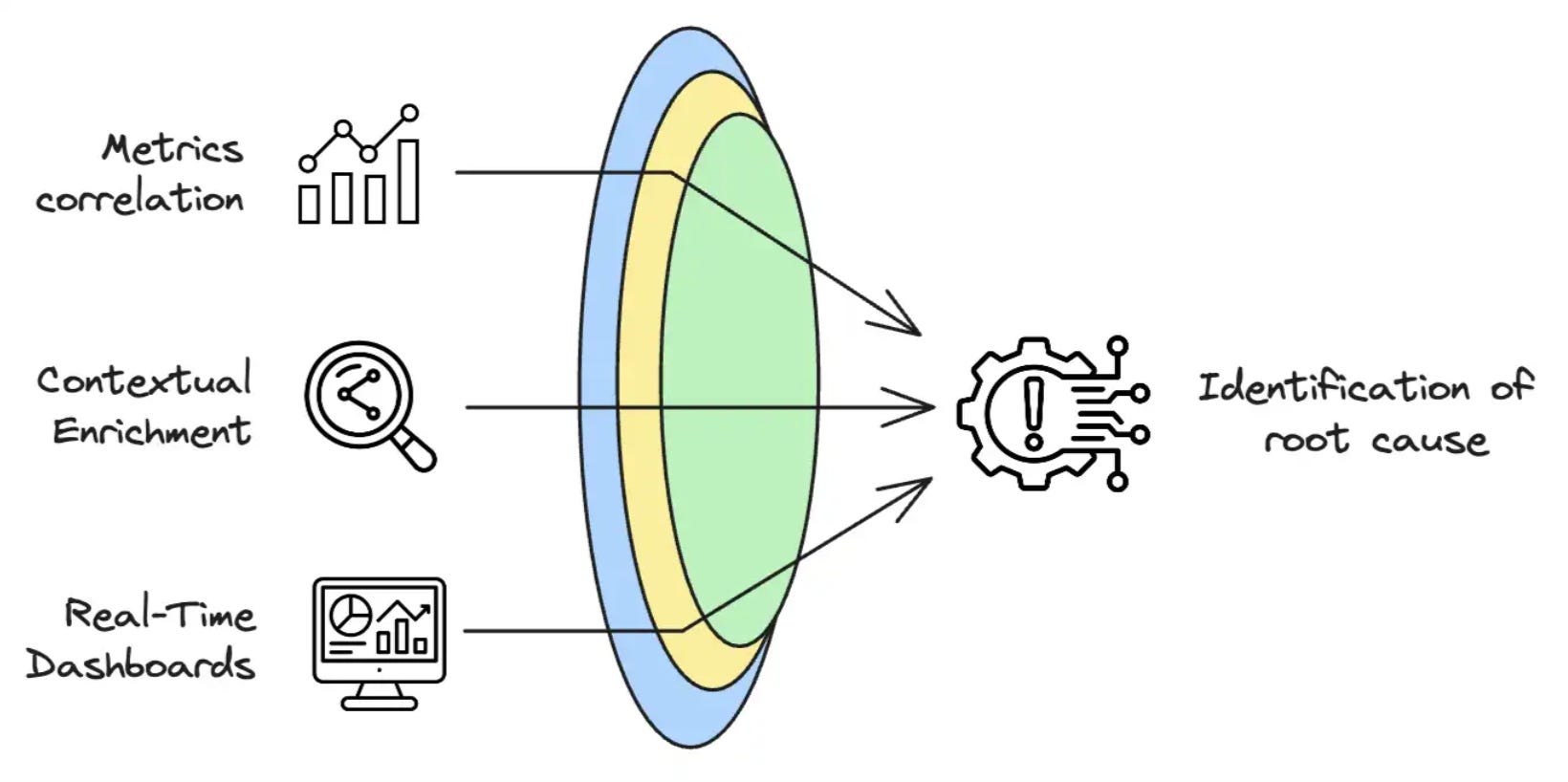
The best tools correlate infrastructure metrics with application logs and traces. They should surface discrepancies, not make me hunt for them. Bonus points if the dashboards update in real time and let me rewind a replay of an incident.
3. Centralized Telemetry
Here’s a hard truth: developers don’t want more observability tools. They want fewer places to look.
If your logs are in one tool, replays in another, and docs in a third, you’re not debugging—you’re triangulating. I look for tools that:
Merge telemetry into a unified view
Allow me to see a full frontend to backend issue, not just fragments
Include all the necessary context (e.g. architecture, dependencies, decisions, etc.)
4. Contextualized Debugging Sessions
Session replays aren’t just for product teams. The ability to watch what happened—frontend to backend, with traces, logs, metrics, and state—all stitched together, is game-changing.
I want tools that show me why something broke:
What version was deployed?
What feature flags were active?
What was the system under load?
Was this reproducible or a perfect storm?
5. Integrated Documentation
This one often gets overlooked but it's a silent killer. If you can’t connect debugging to design decisions, architectural intent, and API behavior, you end up guessing.
Instead of bouncing between Confluence, GitHub, and Postman, your team should have everything in one place.
TL;DR
When I evaluate debugging tools, I’m not just looking for pretty graphs or dashboards. I’m looking for leverage:
Will this reduce context switching?
Will it make postmortems easier to write?
Will it prevent the same bug from happening twice?
Debugging is never going to be “easy,” but with the right tools, it doesn’t have to be slow, siloed, or painful.
💜 This newsletter is sponsored by Multiplayer.app.
Full stack session recording. End-to-end visibility in a single click.
I originally wrote about this topic in this in-depth overview:
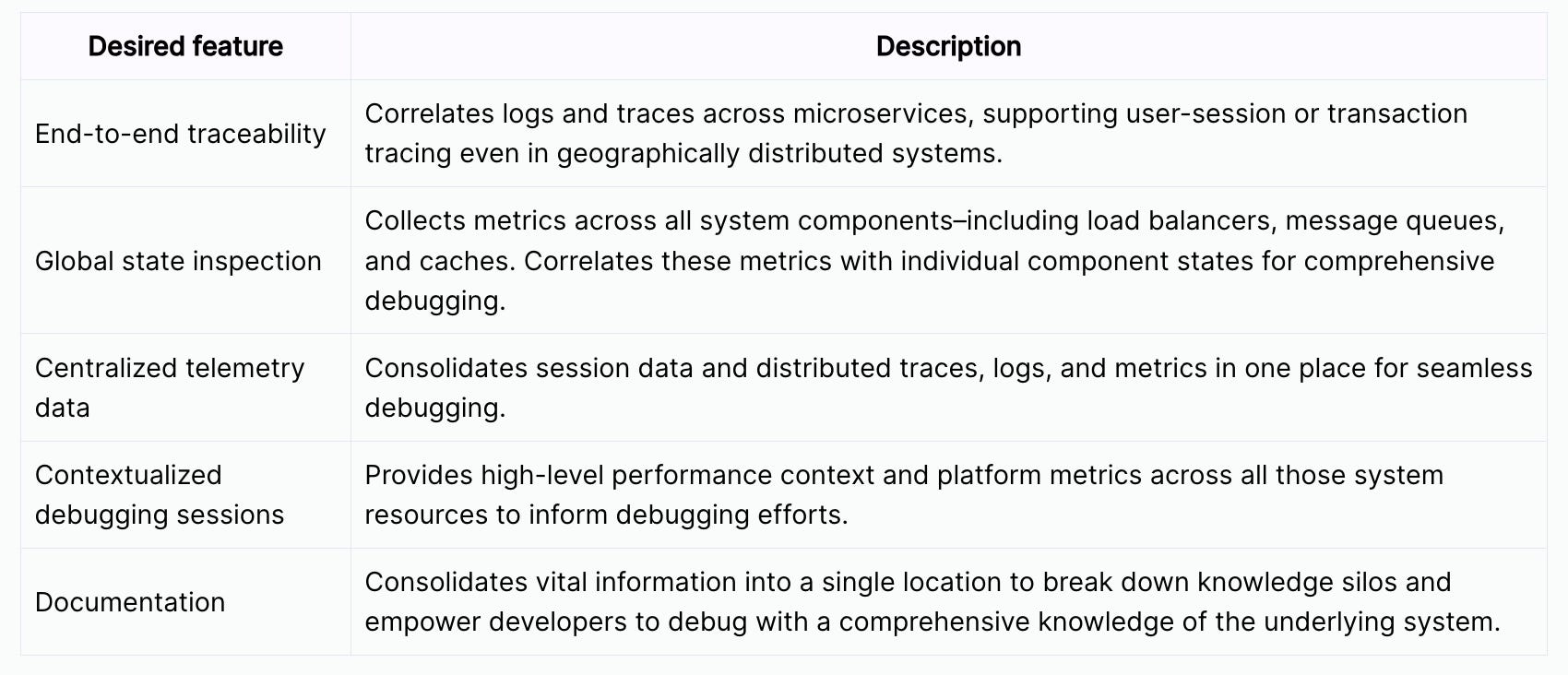
I explored these topics:
End-to-end traceability
Global state inspection
Centralized telemetry data
Contextualized debugging sessions
Documentation
📚 Interesting Articles & Resources
The Future of Observability: Observability 3.0 - Hazel Weakly
Hazel Weakly argues that the next evolution in observability should focus on enabling organizations to act effectively on the insights gathered, rather than just collecting and analyzing data. This involves creating systems where observability tools are not only technical assets but also strategic resources that inform decision-making across various departments, including product, marketing, and operations. The goal is to foster a culture where observability contributes to organizational learning and agility.
Why is observability so expensive? - Matt Klein
Matt Klein addresses the escalating costs associated with observability in modern systems. He identifies that traditional observability approaches often involve collecting vast amounts of data without a clear understanding of its utility, leading to significant storage and processing expenses. Klein advocates for a more strategic approach: collecting only the data necessary for meaningful insights and decision-making.
The IMPOSSIBLE journey: how we made it against all odds - Luca Mezzalira and Raj Saha
This candid conversation between AWS Principal Solutions Architects Luca Mezzalira and Raj Saha is a powerful reminder that career paths in tech are rarely linear, and often forged through adversity, not privilege. Both speakers come from humble beginnings: Luca started in a factory in Italy with no formal qualifications, while Raj started from a modest upbringing in India.
What stands out is not just their success, but how they got there: through persistence, self-belief, and the ability to navigate uncertainty.